SDU Research Reveals Nordic Plastic Recycling Gap Despite Environmental Leadership
Despite their global reputation for environmental leadership, Nordic countries face significant challenges in plastic waste management, according to a new study co-led by Associate Professor Wu Chen from the University of Southern Denmark (SDU). The research, published in ACS Sustainable Resource Management, provides the first comprehensive, polymer-level analysis of plastic flows across all five Nordic nations.
Surprising Findings
The study reveals a stark contrast between the Nordic region’s environmental ambitions and its plastic recycling reality. While these countries have among the world’s most comprehensive policy frameworks for sustainability, less than 6% of plastic waste is actually recycled, with over 70% being incinerated.
Key Insights
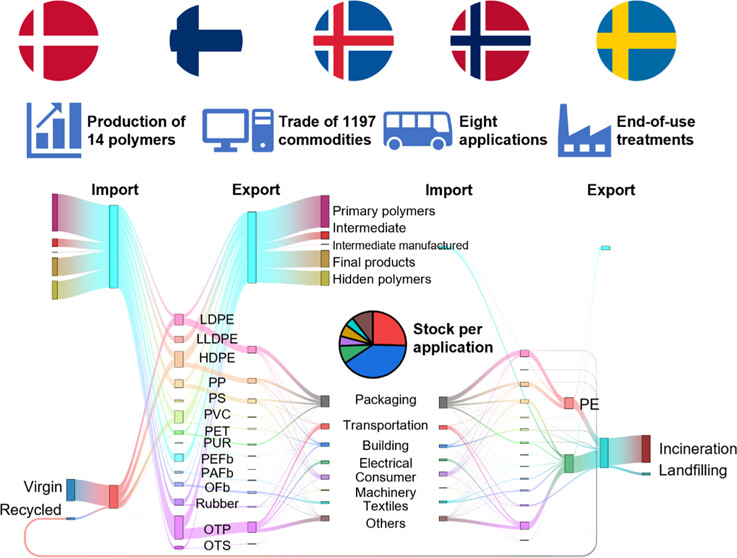
Using dynamic material flow analysis, the team tracked 14 polymer groups across Denmark, Finland, Norway, Sweden, and Iceland from 1978 to 2020, analyzing over 5.4 million trade records:
- Nordic countries have the world’s highest per capita plastic stocks at 1,100 kg per person in 2020, reaching saturation levels.
- Denmark and Norway lead in consumption with over 200 kg per capita annually, far exceeding the European average of 119.4 kg.
- Imports dominate supply: All five countries import more plastic products than they produce domestically.
- Packaging is the main culprit, accounting for one-third of all plastic waste.
- By 2050, unrecycled plastic waste could reach 4.5 million tons annually under business-as-usual scenarios.
The Path Forward
The research evaluated three recycling scenarios to 2050, revealing both opportunities and challenges: Enhanced Mechanical Recycling (R1): Could meet 27% of regional plastic demand but requires expanding current capacity 6.7 times by 2050. Chemical Recycling without Pyrolysis (R2): Could only satisfy 5% of demand, with potential limited by the region’s minimal production capacity for key polymers like PET and polyester fibers. Chemical Recycling with Steam Cracking (R3): Offers the greatest potential at 22% of regional demand, but would reduce unrecycled waste to just 21% of BAU levels. However, current pilot capacity of 16,000 tons/year is far below requirements.
Implications
The study highlights that international cooperation is essential for Nordic countries to achieve their circular economy goals, particularly for chemical recycling where local industrial capacity is limited. Exporting collected plastic waste to countries with established facilities (such as Germany) may be necessary in the short term, while domestic capacity is developed. “As one of the world’s most developed and environmentally conscious regions, the Nordic experience provides critical insights for other regions working to improve plastic waste management,” notes the research team. The findings were supported by multiple funding sources including the EU TREASoURcE project, THRU and Climate-Compatible Packaging initiatives, and China’s National Natural Science Foundation.
Read the full paper
ACS Sustainable Resource Management is an interdisciplinary journal publishing original research on the sustainable management of natural and waste resources, emphasizing systems thinking and planetary boundaries.